
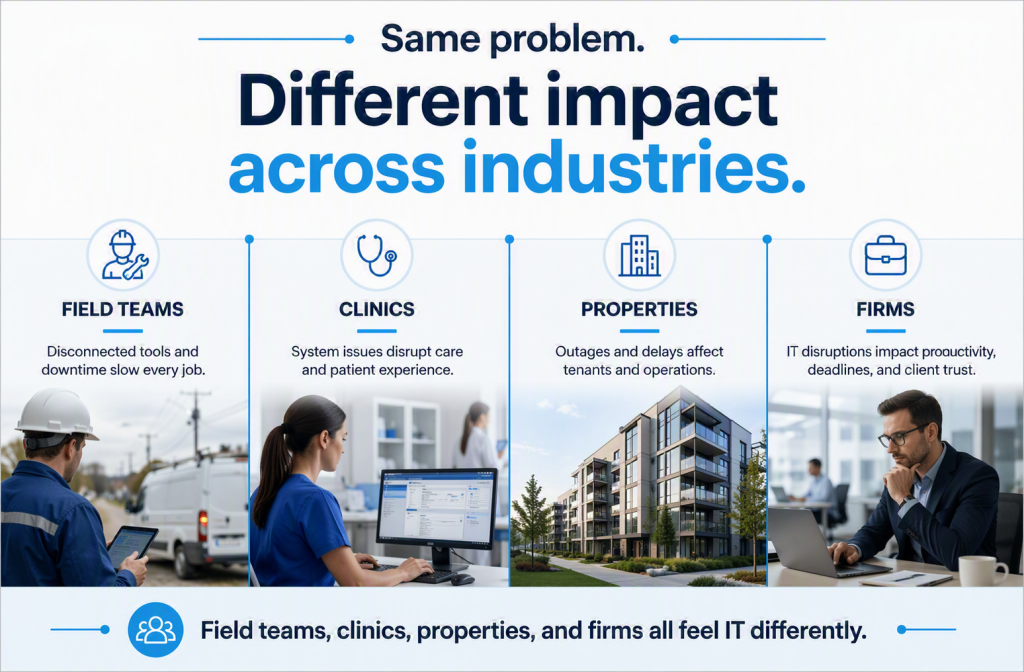
Context Determines Impact
Every organization depends on technology. However, poorly structured IT does not create the same issues everywhere. Instead, the impact shows up differently depending on how the business operates.
In construction and field services, coordination drives performance. As soon as jobsite teams and office staff work from different systems, delays begin to compound. Version control breaks down, access becomes inconsistent, and communication fragments.
As a result, projects slow down and rework increases.
In healthcare and clinics, the priority shifts. Reliability and security carry more weight. Systems must perform consistently while protecting sensitive data. When environments fragment, both operational risk and compliance exposure increase. Consequently, even small issues can escalate quickly.
Property management organizations face a different challenge: scale. As portfolios grow, multiple locations and distributed teams introduce complexity. Without centralized systems, inefficiencies appear quickly. Visibility declines, decisions take longer, and processes lose consistency.
Engineering and technical firms operate under another set of constraints. Data volume, collaboration, and performance all depend on a stable foundation. When that foundation is not in place, productivity drops and risk increases. Over time, both performance and output suffer.
Despite these differences, the pattern is consistent. As operational complexity increases, tolerance for IT inconsistency disappears.
At that point, the role of the environment becomes clear.
It either supports how your business runs or it works against it.