
Most businesses still work this way.
Over time, companies build their IT piece by piece. They add new tools to fix immediate issues, stack systems on top of each other, and make decisions based on short-term needs. This approach is common—and often necessary—but it creates problems that build up over time.
The result is a disconnected environment. Systems don’t talk to each other, data doesn’t match, and workflows break across teams. You see this most clearly between office staff and field teams, where access, communication, and coordination don’t line up.
At the same time, recurring IT issues stick around—not because they can’t be fixed, but because no one has addressed the root cause.
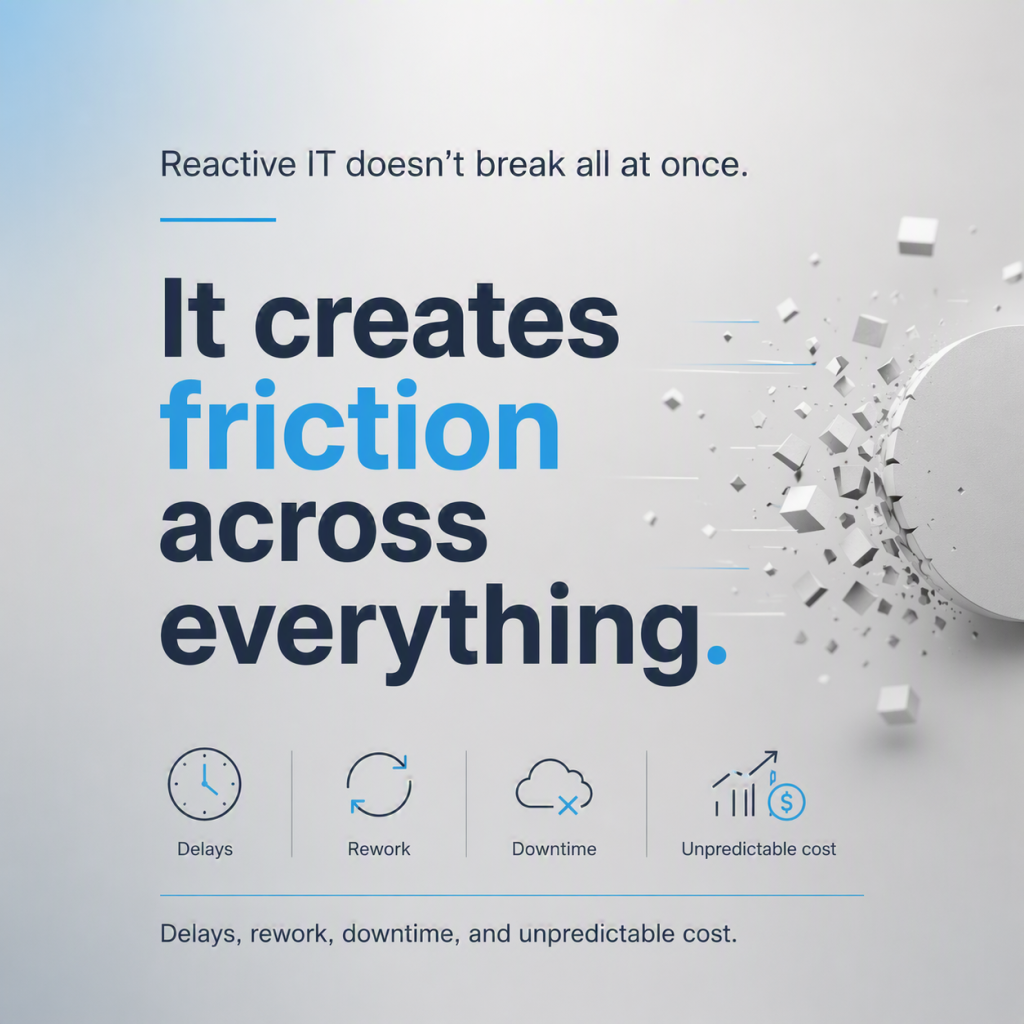
Reactive IT rarely breaks in a big, obvious way. Instead, it adds steady friction to daily work.
That friction shows up in small but costly ways: delayed projects, duplicate work, inconsistent reports, and avoidable downtime. It also leads to unpredictable costs and wasted resources.
Just as important, many companies don’t have a clear view of their risk. They can’t confidently explain how their systems are secured, how their data is protected, or who has access. These gaps often go unnoticed until they cause real operational or financial problems.
In stable conditions, these issues slow the business down. In more challenging environments, they increase risk and limit how well the company can respond.
Reactive IT isn’t just inefficient—it no longer fits how modern businesses need to operate.
Last weeks insight: Business Stability Now Depends On Your IT Environment
Next weeks insight: What A Modern IT Managed Service Provider Actually Delivers