Business conditions across Alberta have shifted in a meaningful and sustained way. Energy volatility, rising costs, labour constraints, and changing demand are no longer occasional disruptions; instead, they now shape daily operations. More importantly, these pressures reflect deeper structural conditions that require a different, more disciplined operating approach.
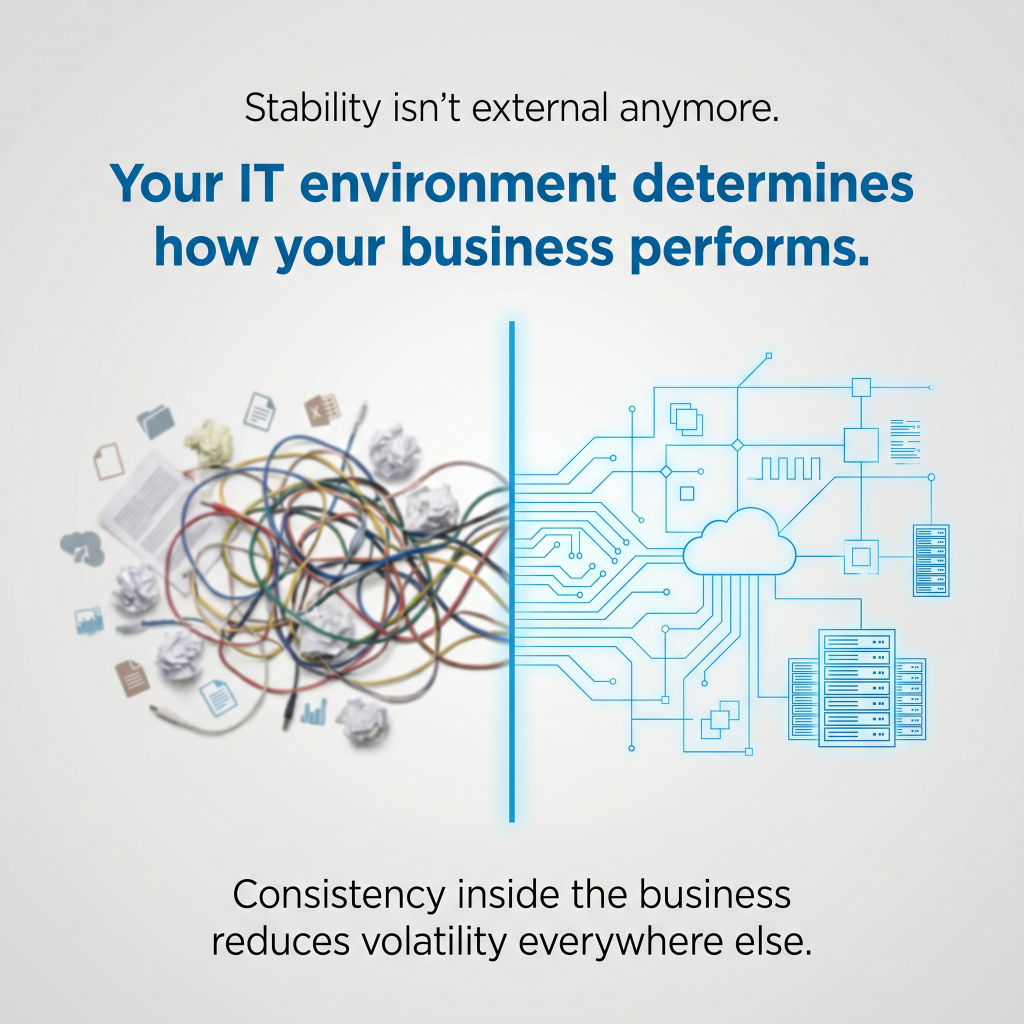
At the same time, many organizations continue to overlook a critical factor: their IT environment. Historically, technology operated in the background, supporting the business without drawing much attention. Today, however, that dynamic has changed. IT now plays a direct role in determining whether operations run smoothly, slow down, or stall under pressure.
As a result, small inconsistencies within systems carry greater consequences. When environments lack structure or reliability, minor issues escalate quickly. Delays begin to compound, communication becomes fragmented, and decision-making loses momentum. Over time, these effects erode execution and limit an organization’s ability to respond effectively.
In more stable markets, businesses could tolerate a degree of inefficiency without significant impact. However, that margin no longer exists. Current conditions demand consistency, predictability, and control. If your IT environment lacks structure, your business inevitably absorbs that instability—often in ways that are not immediately visible but become increasingly costly over time.
Conversely, a well-managed IT environment creates stability where it matters most. It enables consistent execution, supports clear communication, and reduces the likelihood of disruption when conditions tighten. In this context, IT is no longer just a support function; it becomes an operational foundation.
Because of this shift, more organizations are rethinking how they approach IT management. They are moving away from reactive support models and focusing instead on structured, well-governed environments. The priority is no longer simply resolving issues as they arise, but preventing inconsistency altogether.
Ultimately, the conversation has changed. Businesses are not looking for more support—they are prioritizing consistency, accountability, and a clear operating standard that aligns technology with the realities of today’s market.
Explore the next step: The Hidden Risks of Reactive IT in Today’s Environment